
A recent LinkedIn poll we ran showed a telling trend:
33% of professionals said “navigating uncertainty” was their top focus right now.
Not growth.
Not scaling.
Just staying steady in the midst of volatility.
Whether you’re a business owner or an intrapreneur inside a large organization, this isn’t surprising. Our client work echoes the same pattern. From midsize professional services firms to global companies, the pace of change has outstripped the pace of preparation.
And yet—some leaders are moving forward confidently.
They’re not waiting for the fog to lift.
They’re using the fog as a signal.
Let’s explore what that actually means.
1. Trend Tracking vs. Shiny Object Syndrome
Staying informed is essential. But getting swept up in every new tool or trend? That creates noise, not strategy.
In our client work and in reports like Harvard Business Review’s 2024 study on AI decision-load, we’ve seen a clear theme: AI tools promised efficiency but often increased complexity and cognitive fatigue. They don’t replace judgment—they demand more of it.
That’s why resilient leaders ask:
- What’s the use case for us?
- Does this solve a current pain point?
- Will it work with what we already have?
Mindset Shift: Tools should solve problems, not create more decisions. Adopt problem-solving frameworks, not just features.
2. The Backup Plan Isn’t Optional Anymore
The “burn the boats” mentality might have sounded bold in the past. In 2026? It’s reckless.
PwC’s Global Crisis and Resilience Survey showed over 70% of companies were caught off guard by at least one major disruption in the past 24 months. Our own clients have echoed this: tight cash cycles, overreliance on one vertical, or lack of continuity plans created unnecessary panic.
Tactical Moves:
- Run a 3-scenario cash forecast (best/middle/worst case)
- Audit revenue concentration
- Create a fallback system for when tech breaks or teams shift
Leadership Insight: Preparedness isn’t fear. It’s focus.

3. Daily Disciplines Beat Quarterly Sprints
According to MIT Sloan research, leaders with daily systems were 27% more likely to sustain momentum in high-uncertainty periods.
That matches what we’ve seen inside high-performing client teams.
3 Daily Anchors:
- Review revenue movement (What came in? What went out?)
- Follow up with 1-3 key contacts (real relationships build resilience)
- Track energy, not just productivity (sustainability beats burnout)
Mindset Shift: Consistency compounds faster than intensity.
4. Your Systems Need a Refresh
We regularly step into companies where sales is saying one thing, marketing another, and ops is overwhelmed by tools no one fully uses.
McKinsey’s B2B Pulse report confirms this: 60% of marketing leaders lack clear visibility into what’s actually driving ROI.
That’s not a tech stack problem. It’s a coherence problem.
What we recommend:
- Every 6 months, do a System Sync: Audit your CRM, website, email flows, LinkedIn messaging, and CTA’s.
- Look for language misalignment, gaps in follow-up, and duplicated effort.
Reminder: If your system is invisible, it’s uncontrollable.

5. LinkedIn Isn’t the Strategy—It’s the Signal
According to Gartner, B2B buyers engage across 7–10 digital touchpoints before making a decision.
That means if your LinkedIn activity, website, and outreach are disjointed—you’re adding friction.
We use LinkedIn with our clients as a real-time visibility tool, not a posting platform. When aligned with a clear strategy, it allows you to:
- See market movement (job changes, team growth, slowing sectors)
- Validate or test new segments
- Start conversations and warm up real leads
Practical Tip: Don’t let your digital presence fall behind your business intent. Align your messaging, profile, and outreach.
6. Lead Yourself First
Every system relies on one critical factor: you.
In times of uncertainty, leadership isn’t about charisma. It’s about clarity.
We’ve seen highly capable professionals stuck in overwhelm. Not because they’re incapable—but because they’re absorbing too much.
Research from Harvard Business Review on executive overload shows that decision quality drops as mental load rises. And those seen as most competent? They’re often the ones carrying the most complexity.
What to do:
- Build undisturbed space into your day
- Simplify your inputs (fewer tools, fewer open loops)
- Ask: What’s one thing I can remove this week?
As Dr. Marcus Collins said: *”People don’t follow the most charismatic leader. They follow the clearest one.”
Bottom Line: Uncertainty Is a Signal, Not a Stop Sign
The goal isn’t to wait for clarity.
The goal is to create it.
What we’re seeing (and what the research confirms):
- From LinkedIn’s own enforcement updates: Systems are tightening. Strategy matters more than hacks.
- From Gartner and McKinsey: Buyer journeys are longer. Integration beats speed.
- From MIT Sloan and PwC: Resilience is operational, not just emotional.
We help professional services teams, growing consultancies, and enterprise intrapreneurs translate these insights into movement:
- Clarify your messaging
- Map what already exists
- Simplify your systems
- And lead with purpose
When you do that?
Momentum follows.
Need help building a system that works in 2026—not 2019?
Let’s talk.
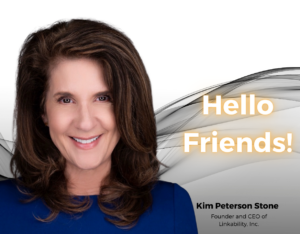
Kim Peterson Stone — three-time founder, keynote speaker, and LinkedIn thought-leader with 225 K+ followers — teaches executives and entrepreneurs how to build unshakable authority, attract targeted opportunities, and future-proof their careers through strategic LinkedIn thought-leadership. As CEO of Linkability.us, she’s helped everyone from startups to Fortune 500 teams work smarter, amplify their influence, and solve their toughest growth challenges.
Ready to become the go-to expert in your field? Let’s talk.