Why most LinkedIn content gets ignored and what professionals should do instead.
We spend a lot of time talking about what works on LinkedIn.
Post consistently.
Use more video.
Write shorter posts.
Write longer posts.
Follow the algorithm.
Try carousels.
Publish at a specific time.
Most of these conversations are based on opinions, assumptions, or whatever tactic happens to be popular at the moment.
Recently, I decided to ask a much simpler question:
What actually makes someone keep reading another person’s LinkedIn content? More than 120 professionals responded.
The results were surprisingly clear.
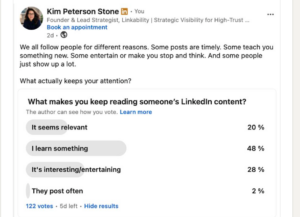
Nearly half said they continue following someone because they learn something. Another meaningful percentage said content keeps their attention when it’s relevant to their world or makes them think.
Only 2% said they keep reading because someone posts often. That result should make all of us stop and think.
For years, professionals have been told that consistency is the secret. Show up more. Post more. Stay visible. While consistency certainly matters, it clearly isn’t the primary reason people pay attention.
People are looking for value.
They’re looking for perspective they can use.
They’re looking for insight that helps them make better decisions.
In other words, the market is telling us exactly what it wants.
The challenge is that most professionals aren’t entirely sure how to create that type of content consistently. This is where many smart people get stuck.
They know their industry. They know their clients. They know their craft. Yet when it’s time to sit down and create content, they freeze.
They assume they need a brilliant idea. They assume they need to sound like the people getting thousands of likes. They assume they need to become content creators.
Most of the time, none of those things are true. The best content rarely starts with content. It starts with observation.
The obvious question becomes:
How do you actually create content people want to learn from?
For most professionals, the answer is simpler than they think.
Start by paying attention.
What questions keep coming up in conversations with clients? What challenges are becoming more common? What assumptions are people making that may no longer be true? What trends are emerging that others haven’t noticed yet?
Those observations are often far more valuable than trying to invent something clever.
Some of the strongest content comes from professionals who simply document what they’re seeing in the marketplace. A consultant may notice the same operational challenge appearing across multiple clients. A recruiter may spot hiring shifts months before they become mainstream. An advisor may see behavioral patterns emerge before anyone publishes a report about them.
That’s where real insight lives.
The value isn’t that you’re reporting the news. The value is that you’re helping people understand what it means.
This is also where many professionals unintentionally go wrong.
Instead of sharing their own observations, they consume large amounts of content from other creators and gradually begin sounding like everyone else. The topics become familiar. The language becomes familiar. Even the graphics start looking the same.
Eventually, everything blends together.
The problem isn’t the format.
The problem is that the perspective is missing.
Ironically, most professionals already possess the thing that would make their content stand out: experience. The challenge is learning how to turn that experience into something useful for other people.

One simple framework is to focus on four types of content:
Share a trend you’re seeing.
Offer a contrarian perspective on conventional wisdom.
Discuss something that recently happened and what can be learned from it.
Or explain how a challenge was handled and what others might take away from the experience.
Those four categories alone can generate months of meaningful content.
The poll revealed something else worth paying attention to.
Twenty-eight percent of respondents said they continue following content because it’s interesting or entertaining.
That’s an important distinction.
Interesting doesn’t necessarily mean becoming an influencer or turning your business into a reality show.
For some people, it may mean sharing behind-the-scenes photos from an event, conference, client project, or community activity.
For others, it could be screenshots of industry conversations, a quick video reacting to a trend, a Canva graphic illustrating a point, or even an AI-generated visual that helps explain a concept.
Some professionals enjoy sharing family moments, hobbies, travel, or personal stories that connect naturally to their work. Others prefer to keep their personal lives private and focus entirely on professional observations.
Both approaches can work.
The key is finding a style that feels authentic to you.
People can usually tell when someone is forcing a personality that doesn’t match who they are.
The goal isn’t to copy what’s working for someone else.
The goal is to communicate your expertise in a way that feels natural, sustainable, and memorable.
Because when people repeatedly see valuable insights combined with a perspective they enjoy consuming, something important begins to happen.
They start understanding how you think.
They start associating you with specific topics.
And when a relevant opportunity appears, they know exactly where you fit.
That’s ultimately what great content is supposed to do.

#Linkability
Kim Peterson Stone — three-time founder, keynote speaker, and LinkedIn thought-leader with 225 K+ followers — teaches executives and entrepreneurs how to build unshakable authority, attract targeted opportunities, and future-proof their careers through strategic LinkedIn thought-leadership. As CEO of Linkability.us, she’s helped everyone from startups to Fortune 500 teams work smarter, amplify their influence, and solve their toughest growth challenges.
Ready to become the go-to expert in your field? Let’s talk.